


update: 25/01/26
Reignition Grammar
Processual Grammar of Spatial Fields in the Plane
Re-gramma is a generative grammar designed to make the internal formation of space visible. It does not describe a figure as a static object; instead, it constructs fields of lines that make it possible to read tensions, thresholds, memories, and latent structures within a geometric matrix.
Griglia infinita Rhombille compressa in un Disco Iperbolico
Note
This document describes the field of Re-gramma in its visual, manual, and processual nature, with reference to the basic core of the method: the construction of line fields within a matrix or geometric domain.
It does not coincide with the operational axioms of the computational grammar, nor with the technical specification of the GL, PSL, and DL engines. The axioms, structural engines, codes, and Topological Hyper-Primitives are addressed in separate documents, in order to keep the description of the method distinct from its computational formalization and its extensions.
More info
For visual experiments, studies, and further information about the Re-gramma field and Reignition Grammar, please refer to Are.na.
Method
Re-gramma is a study of design, form, and the visual construction of space. This document does not aim to theorize anything at a physical or scientific level. References to these fields serve as interpretive tools: they help formalize the method, study it in detail, and clarify certain morphological and structural analogies that emerged throughout the process.
Re-gramma originates from a 12-year practice developed through manual drawing. Starting from a figure, or from a complex matrix, the internal space is constructed through successive propagations of lines, until the figure is led toward an internal zone of equilibrium.
Through their accumulation, the lines effectively generate an internal field.
Re-gramma VL: Socolar-Taylor - tassellatura Rombica a 60° e 120°.
Basic Logic
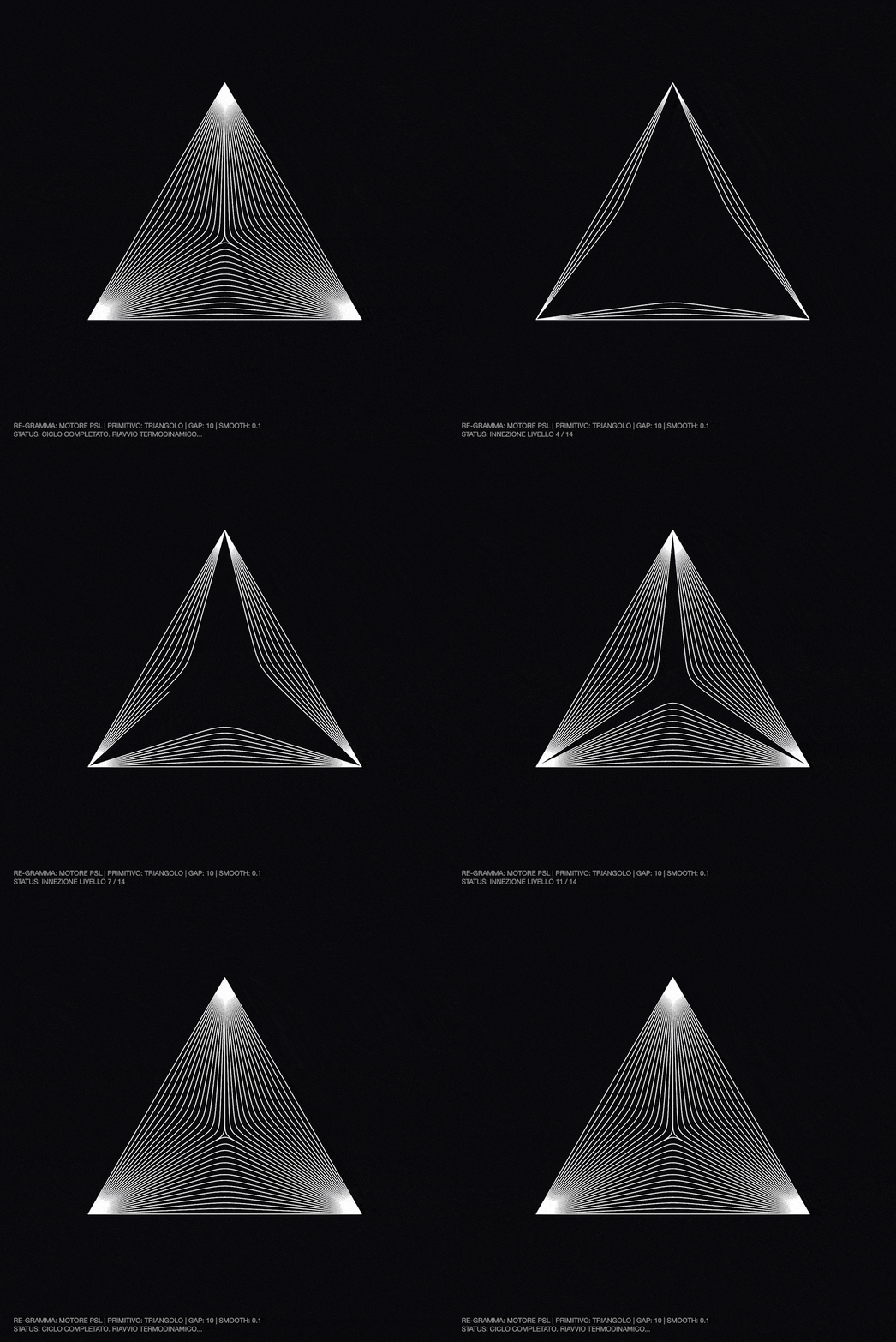
The lines from each side advance as competing fronts. Their domain is not arbitrary, but is determined by contact with the fronts coming from the other sides, exactly as in Voronoi logic.
The method can be read through a sequence of operational conditions: initial poles exist; from these poles, rhythmic propagation is activated; the propagations meet and define internal thresholds; new nodes emerge from these encounters; the field densifies until it reaches saturation.
Three fundamental principles derive from this dynamic:
- Competing propagation: the field arises from the interaction between multiple fronts advancing simultaneously.
- Saturation: the progressive accumulation of lines leads to an internal condition of equilibrium, which may manifest as an emerging center, a threshold, or a zone of field collapse.
- Dissolution of the matrix: the initial figure is progressively absorbed by the field it generates, while remaining active as an implicit architecture.
The final result is not a simple pattern, but a reading of the implicit relationships existing within a matrix or a simple geometric figure.
Griglia infinita Rhombille compressa in un Disco Iperbolico
Structure
What follows is an operational synthesis of the rules observed throughout the process. It serves to clarify how the method works and remains open to verification, extensions, or possible future formalizations.
1) Initial Domain
In the basic core of the method, the process develops within a closed domain. The initial figure is not a simple container: it defines the constraints, symmetries, and equilibrium conditions of the field.
2) Generators
The sides or active portions of the boundary function as generators of the system. From each generator, a family of lines is activated. The number of observed families depends on the structure of the domain or on its operational subdivision.
3) Propagation and Spatial Pressure
The lines progressively develop inward. Their construction is local; therefore, each new line emerges in relation to the previous ones. The lines do not merely occupy empty space, but react to the restriction of the domain by compressing and curving, as if the internal space were opposing resistance or exerting pressure on the advancing front.
4) Competition
The families coexist and advance simultaneously. The domain of influence of each family is not defined a priori; it emerges fluidly through comparison with the others.
5) Collision
When two or more families meet, nodes and internal thresholds are generated. These points are not graphic effects, but true structural elements. Collisions close a cycle and contribute to redefining the operational domain.
6) Emergent Structure
From propagation and collisions, the topology of the field emerges. It may appear as a center of equilibrium, an internal cell, or a threshold configuration. The final structure is not designed a priori, but results from the visual and mathematical behavior of the process.
7) Reignition
A threshold, node, or newly completed internal region can become a new generative condition. In the manual method, this reactivation can be introduced voluntarily through gesture; in the closed computational model, instead, it derives from the internal geometry of the field.
8) Saturation
The field progressively tends to occupy the available space. Saturation does not coincide with a mechanical and uniform filling, but with the achievement of tension and elastic equilibrium between the competing families.
9) Memory of the Structure
The initial order is absorbed, but remains active. Even when it is no longer visible, the shape of the container continues to dictate the orientation and curvature of the internal field.
Reignition
Reignition is the point at which the manual nature of Re-gramma becomes most evident. In manual drawing, the field is not forced to close definitively after a collision or a local saturation. A threshold, a node, or a newly completed internal region can be read as a new active condition and become the origin of a new propagation.
In this case, the human gesture acts as a visual feedback loop. It observes the state of the field, interprets the tensions present within it, and may introduce a new pole, a new line, or a new local matrix without interrupting the coherence of the system, even while freely modifying the matrix.
In the closed computational model, by contrast, this arbitrariness does not belong to the operational core. At present, the code does not freely decide where to reactivate the process. Each new pole must therefore derive from internal conditions of the field: collisions, thresholds, nodes, medial structures, or elements defined in the initial matrix.
For this reason, it is useful to distinguish between manual reignition and physiological computational reignition. The first is open, processual, and depends on the reading of the field during execution. The second is endogenous, deterministic, and must emerge from the geometry of the system itself.
This distinction also concerns the variability of gesture. In the manual method, minimal variations in curvature, pressure, interval, or continuity of the mark are not errors to be corrected, but elements that the field can absorb. Precision does not coincide with mechanical repetition, but with the ability of the lines to maintain relation, distance, and coherence with what has already been traced.
Primitives and Hyper-Primitives
This section brings together the two main levels of application of the method: geometric primitives, which constitute the closed core of the grammar, and Topological Hyper-Primitives, which represent its extension beyond the perimeter.
Geometric Primitives
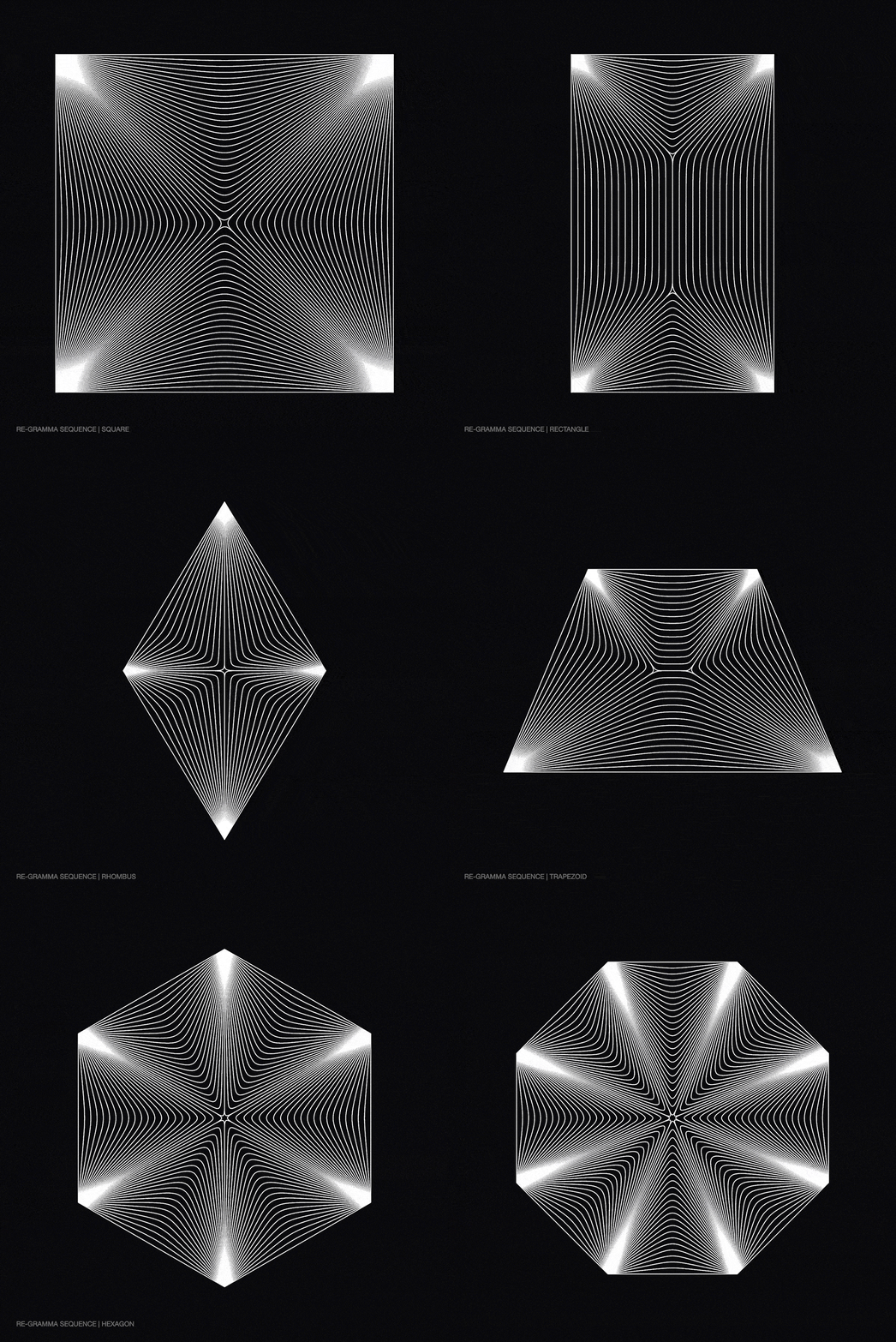
Geometric primitives are elementary figures used as domains for observing the method: square, triangle, circle, rectangle, regular polygons, or other closed forms. They should not be confused with complex matrices, which are already articulated structures composed of multiple cells, nodes, or internal relationships.
In the primitive, the initial figure acts as a unitary domain. The boundary defines the generators, the directions of propagation, and the conditions of collision. In this case, Re-gramma does not read an already subdivided structure, but observes how an internal field can form from an elementary geometry.
Each primitive produces a different configuration: the square makes the competition between opposite and adjacent sides legible; the triangle concentrates tension between three main directions; the circle reduces the hierarchy of sides and leads the system toward a more continuous propagation; regular polygons make it possible to observe the relationship between symmetry, density, and collision.
The role of primitives is therefore methodological: they serve to isolate the basic behavior of the system before applying it to more complex matrices.
Geometric Primitives in Re-gramma
Topological Hyper-Primitives
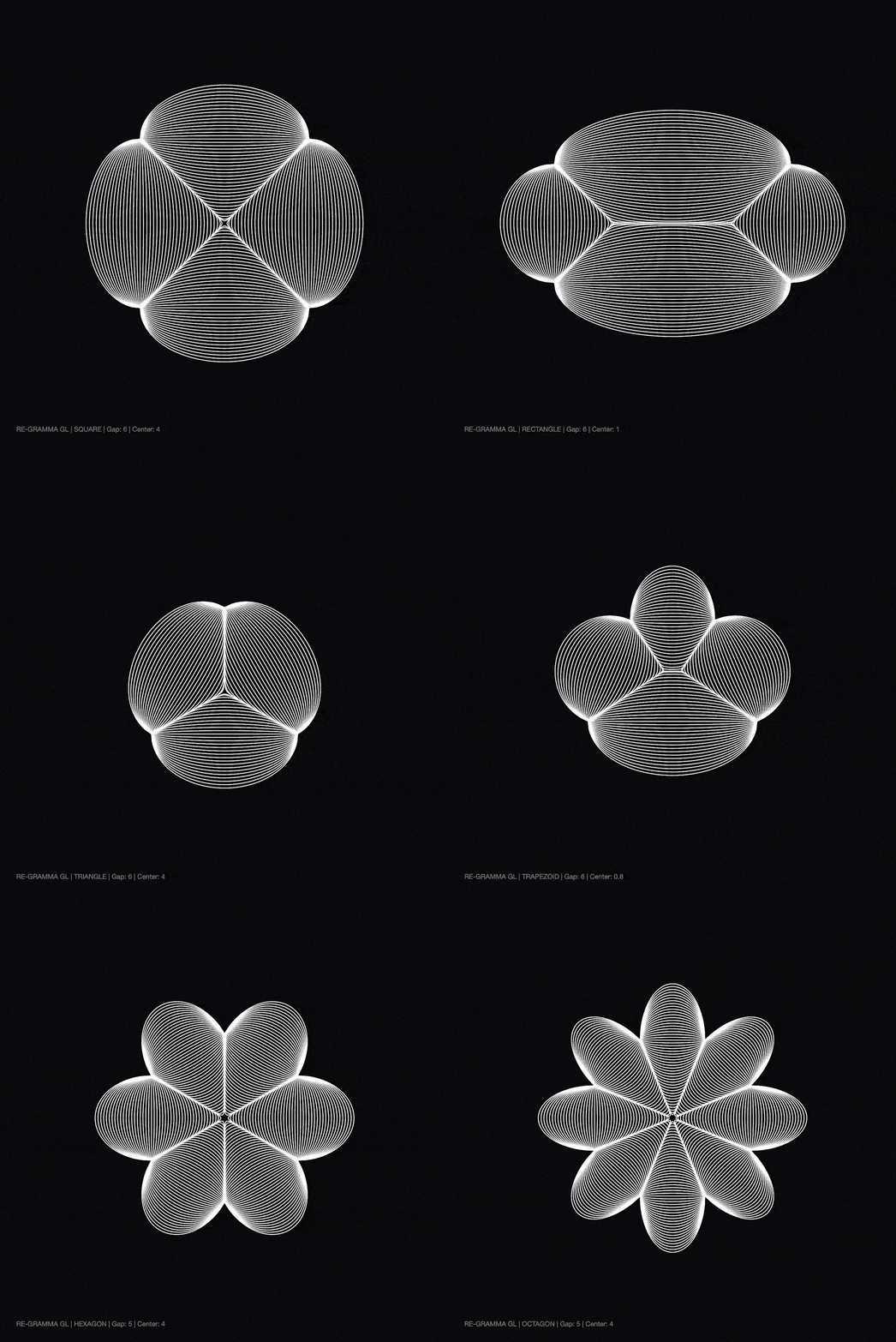
Topological Hyper-Primitives represent an extension of the geometric primitive. In them, the figure does not act only as a closed domain, but as an active threshold between interior and exterior.
The boundary of the primitive can generate continuity beyond the perimeter, transforming the figure into an expanded structure. This extension does not negate the closed core of the method, but locally exceeds it: the closed domain remains the fundamental model for understanding the grammar; the Hyper-Primitive constitutes a broader topological projection of it, in which the perimeter is no longer only a limit, but an interface.
Topological Hyper-Primitives in Re-gramma
Resonances
Resonances do not define the origin of the method, but constitute useful interpretive tools for observing certain behaviors of Re-gramma through already known models, families of forms, and structures. The correspondences described here are therefore phenomenological: they concern the appearance, development, and organization of forms, not a direct derivation or mathematical equivalence.
Field Morphologies
Some configurations generated by Re-gramma show a morphological proximity to representations of physical fields, particularly electrostatic, magnetic, and gravitational field lines.
This relationship should be understood as a visual and structural analogy, not as a scientific equivalence. Re-gramma does not simulate physical forces, electric charges, or masses. The reference to fields is used to describe how a geometric figure can be read as an active domain, crossed by influences, thresholds, tensions, and zones of equilibrium.
In these systems, a distribution of boundary conditions can organize the internal space through lines and curves of equilibrium. In an analogous way, in Re-gramma the sides, poles, or intersections of the initial matrix cease to be simple geometric elements and become active conditions of the field.
The figure is therefore not read only as a perimeter, an area, or a set of segments, but as a system of internal influences. What emerges is not the representation of a physical force, but the visible form of a field produced by the geometry itself.
Geometric Resonances
During the development of the method, several visual correspondences emerged between the configurations generated by Re-gramma and families of curves known in geometry.
In several cases, the field produces morphological transitions similar to the Lamé superellipse: the passage between rigid angle, straight side, and continuous curve is not calculated through the superellipse equation, but emerges from the progressive propagation of the lines and their compression within the domain.
In the square and in certain regular matrices, the families of lines may also generate configurations that recall hyperbolic structures or Minkowski-type diagrams. Here too, the relationship is phenomenological: it concerns the development, tension, and perception of the curves, not a metric transformation of the plane.
Finally, the lines of Re-gramma can be read as successive thresholds of a field in formation: not simple offsets, but progressive traces of a spatial distribution that redefines itself between boundaries, collisions, and zones of equilibrium.
Traditional Geometric Resonances
In comparison with certain traditional geometries, Re-gramma shows affinities with systems based on nodes, cells, internal propagations, and modular continuities, such as certain structures found in Japanese kumiko.
The reference emerged retrospectively, as a structural analogy. In both cases, geometry does not act merely as a contour or decoration, but as a grammar capable of generating internal relationships. The main difference is that in kumiko, propagation remains tied to the constructive module and to physical joinery, whereas in Re-gramma it is abstracted and extended as a field behavior. For this reason, it can operate on regular and irregular forms, composite matrices, tessellations, and complex geometric systems.
Applied to structures such as Penrose tilings, Re-gramma does not simply add a pattern, but makes legible continuities, nuclei, and latent configurations already implicit within the geometric matrix.
Applications to Complex Matrices
Re-gramma can be applied not only to simple geometric primitives, but also to already structured matrices, such as tessellations, modular grids, or aperiodic configurations. In these cases, the method does not merely occupy the available space, but rereads the matrix as a field, redefining the relationships between boundaries, nodes, thresholds, and internal continuities.
Voronoi Diagrams and Propagation Matrices
Re-gramma can also be applied to matrices built on Voronoi diagrams or on related systems of spatial subdivision. In this case, the diagram is not taken as the generative model of the method, but as a starting structure onto which a second grammar of lines is grafted.
Voronoi logic already makes explicit a subdivision of space into domains of influence. Re-gramma intervenes on this matrix by transforming rigid boundaries into active thresholds, fields of compression, and internal relationships between cells. The initial diagram remains legible as a latent structure, but is absorbed into a more continuous field.
Some results of Re-gramma may also make visible structures related to the medial axis, the straight skeleton, or the collision of fronts. These elements are not necessarily calculated as in a classical geometric algorithm, but may emerge as visual and processual outcomes of the encounter between competing propagations.
The value of the application therefore does not lie in replicating Voronoi, but in rereading it: Re-gramma uses the matrix as a field of activation and brings to the surface tensions, thresholds, and continuities that are not immediately perceptible in the initial grid alone.
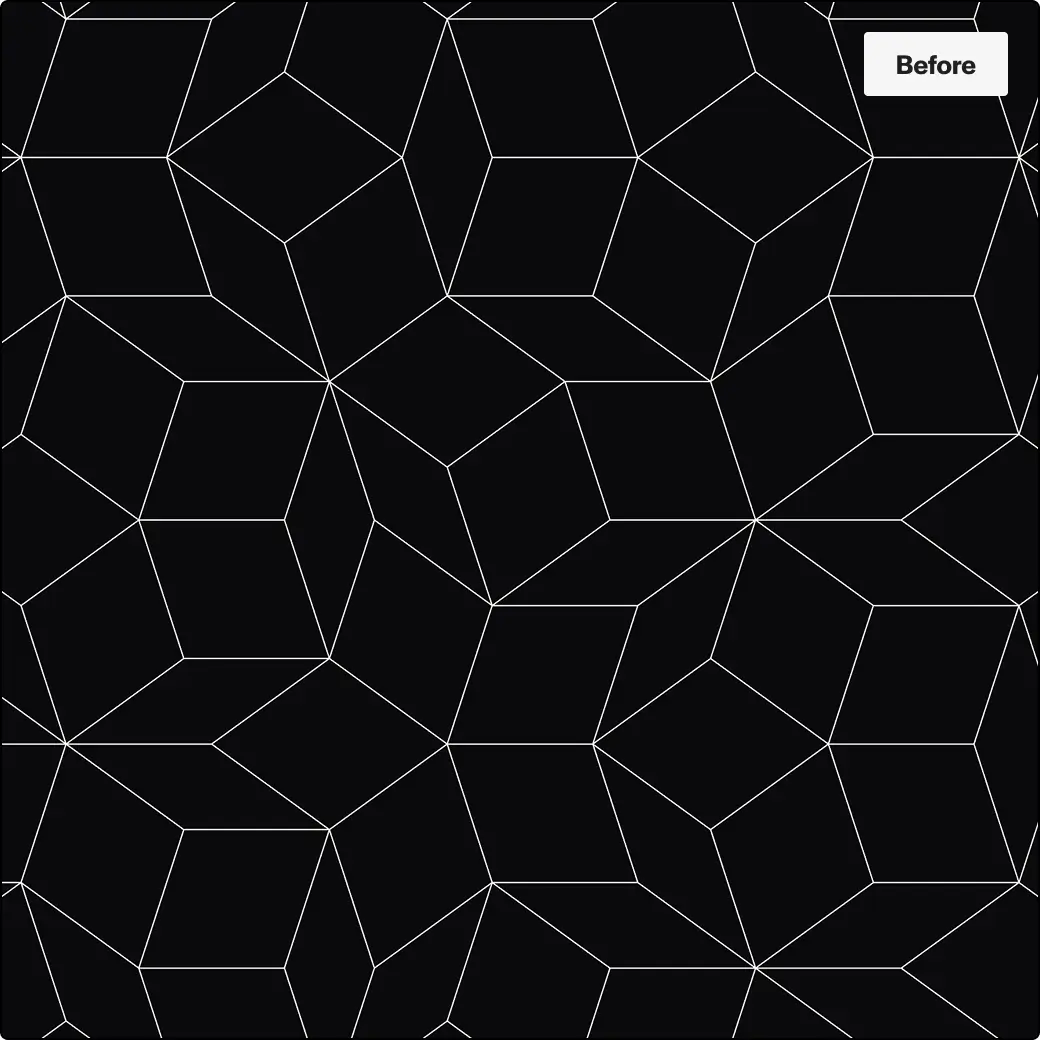
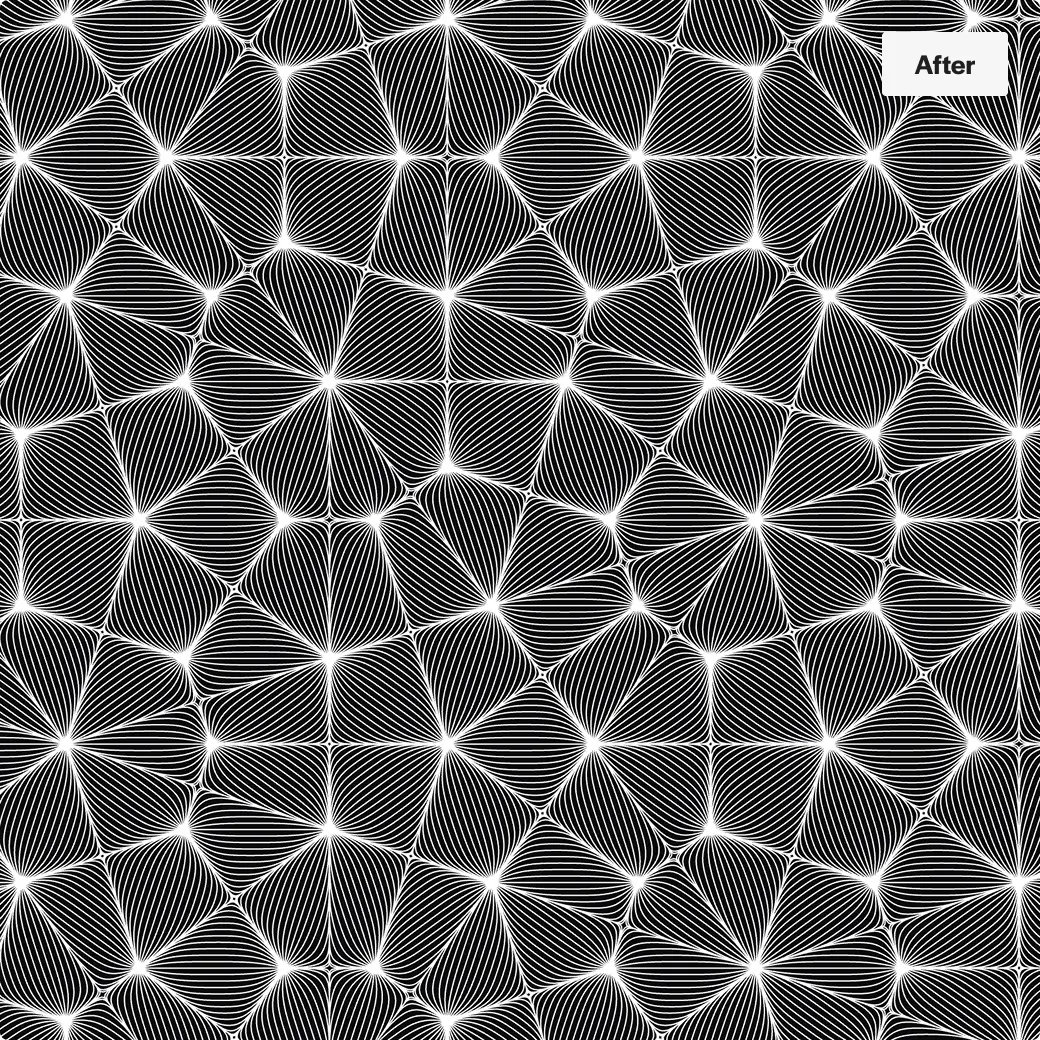
Penrose Tiling
The application of Re-gramma to Penrose tiling produces a structural rereading of the matrix. The method does not add decoration to the surface, but transforms the way the grid is perceived: the initial fragments cease to appear as isolated units and are brought back into a continuous field of relationships.
In this sense, Re-gramma does not replace the Penrose matrix, but absorbs and reactivates it, allowing a higher-order structure to emerge — one that was already implicit in the starting geometry.
Penrose Tiling through Reignition Grammar
Poincaré Disk and Latent Topology
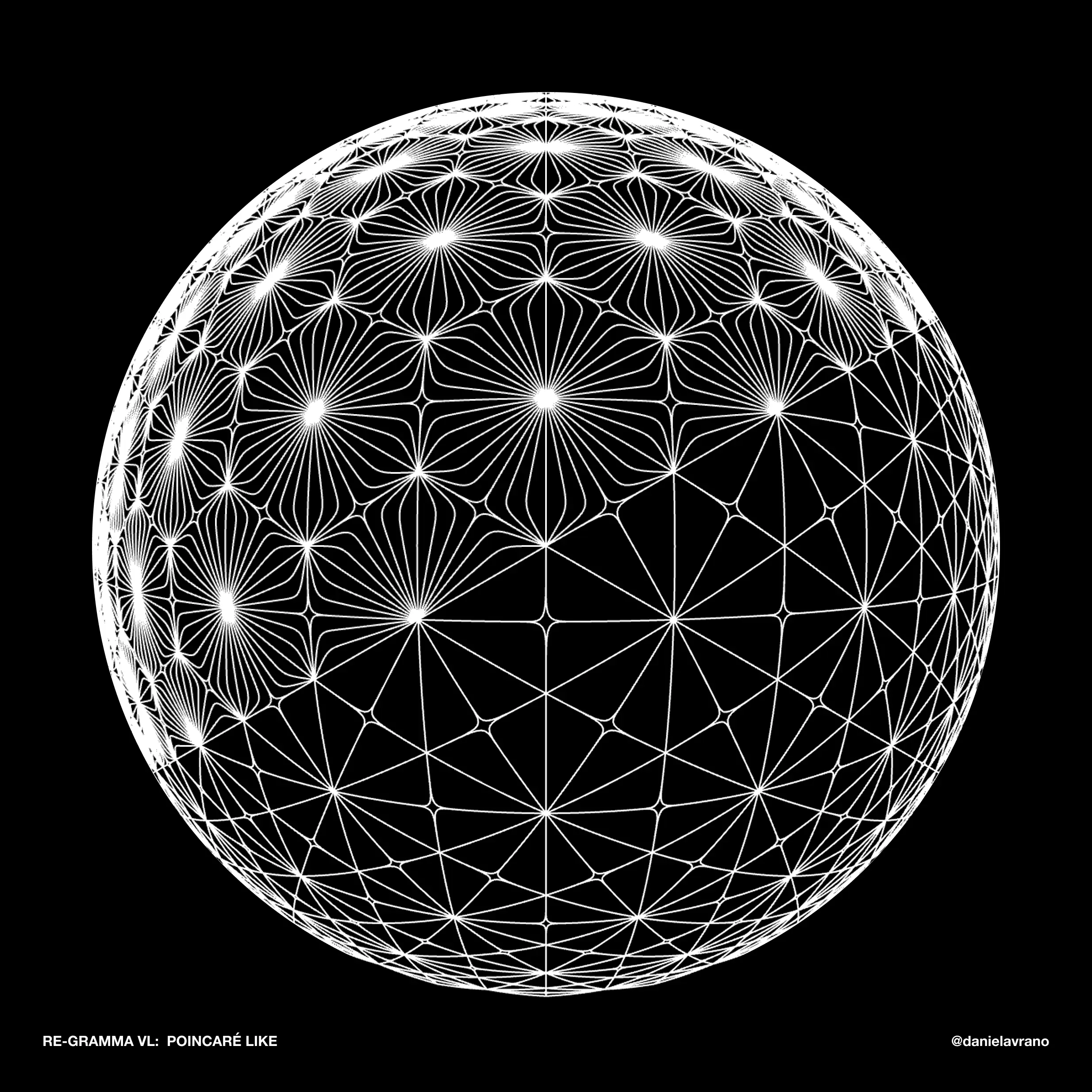
This experiment shows Re-gramma’s ability to operate on a non-Euclidean matrix. The method is not applied to a traditional planar grid, but is grafted within a hyperbolic {7,3} tessellation constructed according to the Poincaré Disk model.
The dynamic develops through a hybrid approach. The host matrix is defined analytically: the system calculates the hyperbolic boundaries of the mother cell through geodesics and Möbius inversions. Re-gramma is then grafted onto this structure, intervening within the cell by calculating a first structural threshold, readable as the primary isocline of the field.
Through Möbius inversions, the mother cell and its internal structure are reflected and propagated toward the boundary circle. Re-gramma does not autonomously generate hyperbolic space, but uses it as an operational domain, making visible thresholds, dual structures, and internal relationships that progressively densify toward the boundary.
Hyperbolic geometry provides the matrix, while Re-gramma traverses it as a field grammar, bringing to the surface internal relationships that would remain less legible in the tessellation alone.
Subtraction of the mantle and revelation of the field’s latent thresholds.
Formalization
Some logics of the process are already legible and algorithmically testable in regular geometric figures, such as harmonic fields and spatial relaxation. The complete extension of the method to more complex systems remains part of an open research path.
The algorithmic component does not replace the manual matrix of the method. It is a line of study useful for verifying the structural behaviors of the grammar. At the current stage, the unpredictable behavior of manual reignition and the organic redefinition of the matrix remain exclusive properties of human execution.
Within the closed computational core, Re-gramma must instead operate through an initial domain, boundary generators, a resolution law chosen a priori, collisions, thresholds, saturation, and any physiological reignition generated by the field. The codes of internal geometric primitives constitute a laboratory for testing this closed core; Topological Hyper-Primitives, instead, represent an In & Out extension, to be treated separately from the basic 2D grammar.
For this reason, it is useful to keep two levels separate: on one side, internal Re-gramma applied to closed geometric primitives; on the other, Topological Hyper-Primitives, in which the matrix becomes an interface and the field can also extend beyond the boundary.
Considerations
What follows is an operational synthesis of the rules observed throughout the process. It serves to clarify how the method works and remains open to verification, extensions, or possible future formalizations.
1) Relations over Object
Given a matrix, the accumulation of lines progressively dissolves the individual starting elements. What becomes legible is no longer the initial scheme, but the relationships, pressures, and tensions established between the poles.
2) Construction through Accumulation
Space is not given, but constructed. From an empty plane, a complex surface develops through the repetitive application of an elementary rule. The field defines itself through continuity and progressive densification.
3) Formation of Space
The method does not describe a space, but observes how space forms. It is not a static representation, but the visible trace of a geometric behavior that evolves over time.
4) Integration of the Variable
The process accepts and feeds on the manual nature of execution. The system is sufficiently robust to transform irregularities or variations in pressure into formal deviations that enrich, rather than compromise, the topology of the figure.
5) Emergent Dynamics
Although it starts from rigid matrices, the outcome is deeply organic. In the manual method, every intersection or newly traced line can reactivate the process, transforming a closure into a new operational matrix and allowing the field to continue expanding, adapting, and breathing. In the closed computational model, this reactivation must instead be treated as physiological reignition: an event generated by the internal geometry of the field.
Reignition Grammar
Grammatica processuale di campi spaziali nel piano
Re-gramma è una grammatica generativa per rendere visibile la formazione interna dello spazio. Non descrive una figura come oggetto statico, ma costruisce campi di linee che permettono di leggere tensioni, soglie, memorie e strutture latenti dentro una matrice geometrica.
Griglia infinita Rhombille compressa in un Disco Iperbolico
Nota
Questo documento descrive il campo di Re-gramma nella sua natura visiva, manuale e processuale, con riferimento al nucleo base del metodo: la costruzione di campi di linee all’interno di una matrice o di un dominio geometrico.
Non coincide con gli assiomi operativi della grammatica computazionale, né con la specifica tecnica dei motori GL, PSL e DL. Gli assiomi, i motori strutturali, i codici e gli Iper-Primitivi Topologici vengono trattati in documenti separati, così da mantenere distinta la descrizione del metodo dalla sua formalizzazione computazionale e dalle sue estensioni.
Per maggiori info
Per esperimenti visivi, studi e maggiori info riguardo il campo Re-gramma e Reignition Grammar consultare Are.na.
Metodo
Re-gramma è uno studio sul design, sulla forma e sulla costruzione visiva dello spazio. Questo documento non intende teorizzare nulla sul piano fisico o scientifico. I richiami a questi campi servono come strumenti di lettura, aiutano a formalizzare il metodo, studiarlo nel dettaglio e chiarire alcune analogie morfologiche e strutturali emerse nel processo.
Re-gramma nasce da una pratica di 12 anni sviluppata attraverso il disegno manuale. Partendo da una figura, o da una matrice complessa, si costruisce lo spazio interno attraverso propagazioni successive di linee fino a condurre la figura verso una zona interna di equilibrio.
Le linee generano di fatto un campo interno attraverso il loro accumulo.
Re-gramma VL: Socolar-Taylor - tassellatura Rombica a 60° e 120°.
Logica base
Le linee di ciascun lato avanzano come fronti concorrenti. Il loro dominio non è arbitrario, ma viene determinato dal contatto con i fronti provenienti dagli altri lati, esattamente come nella logica del Voronoi.
Il metodo può essere letto attraverso una sequenza di condizioni operative:
esistono poli iniziali;
dai poli si attiva una propagazione ritmica;
le propagazioni si incontrano e definiscono soglie interne;
dagli incontri emergono nuovi nodi;
il campo si addensa fino alla saturazione.
Da questa dinamica derivano tre principi fondamentali
- La propagazione concorrente: il campo nasce dall’interazione tra fronti multipli che avanzano simultaneamente.
- La saturazione: l’accumulo progressivo delle linee conduce a una condizione di equilibrio interna, che può manifestarsi come centro emergente, soglia o zona di collasso del campo.
- La dissoluzione della matrice: la figura iniziale viene progressivamente assorbita dal campo che genera, restando attiva come architettura implicita.
Il risultato finale non è un semplice pattern, ma la lettura delle relazioni implicitamente esistenti all’interno di una matrice o di una semplice figura geometrica.
Griglia infinita Rhombille compressa in un Disco Iperbolico
Struttura
Quello che segue è una sintesi operativa delle regole osservate nel processo. Serve a chiarire il funzionamento del metodo e rimane aperta a verifiche, estensioni o possibili formalizzazioni future.
1) Dominio iniziale
Nel nucleo base del metodo, il processo si sviluppa all’interno di un dominio chiuso. La figura iniziale non è un semplice contenitore: definisce i vincoli, le simmetrie e le condizioni di equilibrio del campo.
2) Generatori
I lati o le porzioni attive del bordo funzionano come generatori del sistema. Da ciascun generatore si attiva una famiglia di linee. Il numero delle famiglie osservate dipende dalla struttura del dominio o dalla sua suddivisione operativa.
3) Propagazione e Pressione Spaziale
Le linee si sviluppano progressivamente verso l’interno. La loro costruzione è locale, dunque ogni nuova linea nasce in relazione alle precedenti. Le linee non si limitano a occupare spazio vuoto ma reagiscono alla restrizione del dominio comprimendosi e curvando, come se lo spazio interno opponesse resistenza o esercitasse una pressione sul fronte di avanzamento.
4) Concorrenza
Le famiglie coesistono e avanzano simultaneamente. Il dominio di influenza di ciascuna non è definito a priori, emerge fluidamente dal confronto con le altre.
5) Collisione
Quando due o più famiglie si incontrano si generano nodi e soglie interne. Questi punti non sono effetti grafici ma veri e propri elementi strutturali. Le collisioni chiudono un ciclo e contribuiscono a ridefinire il dominio operativo.
6) Struttura emergente
Dalla propagazione e dalle collisioni emerge la topologia del campo. Questa può manifestarsi come centro di equilibrio, cella interna o configurazione di soglia. La struttura finale non è progettata a priori, ma deriva dal comportamento visivo e matematico del processo.
7) Reinnesco
Una soglia, un nodo o una regione interna appena conclusa può diventare una nuova condizione generativa. Nel metodo manuale questa riattivazione può essere introdotta dal gesto volontariamente; nel modello computazionale chiuso invece deriva dalla geometria interna del campo.
8) Saturazione
Il campo tende progressivamente a occupare lo spazio disponibile. La saturazione non coincide con un riempimento meccanico e uniforme, ma con il raggiungimento di una tensione e di un equilibrio elastico tra le famiglie concorrenti.
9) Memoria della struttura
L’ordine di partenza viene assorbito, ma resta attivo. Anche quando non è più visibile la forma del contenitore continua a dettare l’orientamento e la curvatura del campo interno.
Reinnesco
Il reinnesco è il punto in cui la natura manuale di Re-gramma diventa più evidente. Nel disegno manuale il campo non è obbligato a chiudersi definitivamente dopo una collisione o una saturazione locale. Una soglia, un nodo o una regione interna appena conclusa può essere letta come nuova condizione attiva e diventare origine di una nuova propagazione.
In questo caso il gesto umano agisce come anello di retroazione visiva. Osserva lo stato del campo, interpreta le tensioni presenti e può introdurre un nuovo polo, una nuova linea o una nuova matrice locale senza interrompere la coerenza del sistema.
Nel modello computazionale chiuso, invece, questa arbitrarietà non appartiene al nucleo operativo. Il codice al momento non decide liberamente dove riattivare il processo. Ogni nuovo polo deve quindi derivare da condizioni interne al campo: collisioni, soglie, nodi, strutture mediali o elementi definiti nella matrice iniziale.
Per questo è utile distinguere tra reinnesco manuale e reinnesco fisiologico computazionale. Il primo è aperto, processuale e dipende dalla lettura del campo durante l’esecuzione. Il secondo è endogeno, deterministico e deve emergere dalla geometria stessa del sistema.
Questa distinzione riguarda anche la variabilità del gesto. Nel metodo manuale, minime variazioni di curvatura, pressione, intervallo o continuità del segno non sono errori da correggere, ma elementi che il campo può assorbire. La precisione non coincide con la ripetizione meccanica, ma con la capacità delle linee di mantenere relazione, distanza e coerenza con ciò che è già stato tracciato.
Primitivi e iper-primitivi
Questa sezione raccoglie i due livelli principali di applicazione del metodo: i primitivi geometrici, che costituiscono il nucleo chiuso della grammatica, e gli Iper-Primitivi Topologici, che ne rappresentano l’estensione oltre il perimetro.
Primitivi geometrici
I primitivi geometrici sono figure elementari usate come domini di osservazione del metodo: quadrato, triangolo, cerchio, rettangolo, poligoni regolari o altre forme chiuse. Non vanno confusi con le matrici complesse, che sono strutture già articolate e composte da più celle, nodi o relazioni interne.
Nel primitivo, la figura di partenza agisce come dominio unitario. Il bordo definisce i generatori, le direzioni di propagazione e le condizioni di collisione. In questo caso, Re-gramma non legge una struttura già suddivisa, ma osserva come un campo interno può formarsi a partire da una geometria elementare.
Ogni primitivo produce una configurazione diversa: il quadrato rende leggibile la concorrenza tra lati opposti e adiacenti; il triangolo concentra la tensione tra tre direzioni principali; il cerchio riduce la gerarchia dei lati e porta il sistema verso una propagazione più continua; i poligoni regolari permettono di osservare la relazione tra simmetria, densità e collisione.
Il ruolo dei primitivi è quindi metodologico: servono a isolare il comportamento di base del sistema prima di applicarlo a matrici più complesse.
Primitivi geometrici in Re-gramma
Iper-Primitivi Topologici
Gli Iper-Primitivi Topologici rappresentano un’estensione del primitivo geometrico. In essi la figura non agisce solo come dominio chiuso, ma come soglia attiva tra interno ed esterno.
Il bordo del primitivo può generare continuità oltre il perimetro, trasformando la figura in una struttura espansa. Questa estensione non annulla il nucleo chiuso del metodo, ma lo supera localmente: il dominio chiuso resta il modello fondamentale per comprendere la grammatica; l’Iper-Primitivo ne costituisce una proiezione topologica più ampia, in cui il perimetro non è più soltanto limite, ma interfaccia.
Iper-Primitivi Topologici in Re-gramma
Risonanze
Le risonanze non definiscono l’origine del metodo, ma costituiscono strumenti di lettura utili per osservare alcuni comportamenti di Re-gramma attraverso modelli, famiglie di forme e strutture già note. Le corrispondenze qui descritte sono quindi fenomenologiche: riguardano l’aspetto, l’andamento e l’organizzazione delle forme, non una derivazione diretta o un’equivalenza matematica.
Morfologie di campo
Alcune configurazioni generate da Re-gramma mostrano una prossimità morfologica con le rappresentazioni dei campi fisici, in particolare con linee di campo elettrostatiche, magnetiche e gravitazionali.
Questa relazione va intesa come analogia visiva e strutturale, non come equivalenza scientifica. Re-gramma non simula forze fisiche, cariche elettriche o masse. Il riferimento ai campi è utilizzato per descrivere come una figura geometrica possa essere letta come dominio attivo, attraversato da influenze, soglie, tensioni e zone di equilibrio.
In questi sistemi, una distribuzione di condizioni al bordo può organizzare lo spazio interno attraverso linee e curve di equilibrio. In modo analogo, in Re-gramma i lati, i poli o le intersezioni della matrice iniziale cessano di essere semplici elementi geometrici e diventano condizioni attive del campo.
La figura non viene quindi letta soltanto come perimetro, area o insieme di segmenti, ma come sistema di influenze interne. Ciò che emerge non è la rappresentazione di una forza fisica, ma la forma visibile di un campo prodotto dalla geometria stessa.
Risonanze geometriche
Nel corso dello sviluppo del metodo sono emerse alcune corrispondenze visive tra le configurazioni generate da Re-gramma e famiglie di curve note in geometria.
In diversi casi, il campo produce transizioni morfologiche affini alla superellisse di Lamé: il passaggio tra angolo rigido, lato rettilineo e curva continua non viene calcolato tramite l’equazione della superellisse, ma emerge dalla propagazione progressiva delle linee e dalla loro compressione all’interno del dominio.
Nel quadrato e in alcune matrici regolari, le famiglie di linee possono inoltre generare configurazioni che richiamano strutture iperboliche o diagrammi di tipo Minkowski. Anche in questo caso la relazione è fenomenologica: riguarda l’andamento, la tensione e la percezione delle curve, non una trasformazione metrica del piano.
Le linee di Re-gramma possono infine essere lette come soglie successive di un campo in formazione: non semplici offset, ma tracce progressive di una distribuzione spaziale che si ridefinisce tra bordi, collisioni e zone di equilibrio.
Risonanze geometriche tradizionali
Nel confronto con alcune geometrie tradizionali, Re-gramma mostra affinità con sistemi basati su nodi, celle, propagazioni interne e continuità modulari, come alcune strutture del kumiko giapponese.
Il riferimento è emerso a posteriori, come analogia strutturale. In entrambi i casi la geometria non agisce solo come contorno o decorazione, ma come grammatica capace di generare relazioni interne.
La differenza principale è che nel kumiko la propagazione resta legata al modulo costruttivo e all’incastro fisico, mentre in Re-gramma viene astratta ed estesa come comportamento di campo. Per questo può agire su forme regolari e irregolari, matrici composte, tassellazioni e sistemi geometrici complessi.
Applicato a strutture come le tassellazioni di Penrose, Re-gramma non aggiunge semplicemente un pattern, ma rende leggibili continuità, nuclei e configurazioni latenti già implicite nella matrice geometrica.
Applicazioni su matrici complesse
Re-gramma può essere applicato non solo a primitivi geometrici semplici, ma anche a matrici già strutturate, come tassellazioni, griglie modulari o configurazioni aperiodiche. In questi casi il metodo non si limita a occupare lo spazio disponibile, ma rilegge la matrice come campo, ridefinendo i rapporti tra bordi, nodi, soglie e continuità interne.
Diagrammi di Voronoi e matrici di propagazione
Re-gramma può essere applicato anche a matrici costruite su diagrammi di Voronoi o su sistemi affini di suddivisione dello spazio. In questo caso il diagramma non viene assunto come modello generativo del metodo, ma come struttura di partenza su cui innestare una seconda grammatica di linee.
La logica di Voronoi rende già esplicita una suddivisione dello spazio in domini di influenza. Re-gramma interviene su questa matrice trasformando i confini rigidi in soglie attive, campi di compressione e relazioni interne tra celle. Il diagramma iniziale resta leggibile come struttura latente, ma viene assorbito da un campo più continuo.
Alcuni risultati di Re-gramma possono inoltre rendere visibili strutture affini all’asse mediale, allo straight skeleton o alla collisione di fronti. Questi elementi non vengono necessariamente calcolati come in un algoritmo geometrico classico, ma possono emergere come esiti visivi e processuali dell’incontro tra propagazioni concorrenti.
Il valore dell’applicazione non sta quindi nel replicare Voronoi, ma nel rileggerlo: Re-gramma usa la matrice come campo di attivazione e ne porta in superficie tensioni, soglie e continuità non immediatamente percepibili nella sola griglia iniziale.
Tassellatura di Penrose
L’applicazione di Re-gramma alla tassellatura di Penrose produce una rilettura strutturale della matrice. Il metodo non aggiunge una decorazione alla superficie, ma trasforma il modo in cui la griglia viene percepita: i frammenti iniziali cessano di apparire come unità isolate e vengono ricondotti a un campo continuo di relazioni.
In questo senso, Re-gramma non sostituisce la matrice di Penrose, ma la assorbe e la riattiva, facendo emergere una struttura di ordine superiore che era già implicita nella geometria di partenza.
Tassellatura di Penrose attraverso Reignition Grammar
Disco di Poincaré e topologia latente
Questo esperimento mostra la capacità di Re-gramma di operare su una matrice non-euclidea. Il metodo non viene applicato a una griglia piana tradizionale, ma innestato all’interno di una tassellazione iperbolica {7,3} costruita secondo il modello del Disco di Poincaré.
La dinamica si sviluppa attraverso un approccio ibrido. La matrice ospite viene definita analiticamente: il sistema calcola i confini iperbolici della cella madre attraverso geodetiche e inversioni di Möbius. Su questa struttura viene poi innestato Re-gramma, che interviene all’interno della cella calcolando una prima soglia strutturale, leggibile come isoclina primaria del campo.
Attraverso le inversioni di Möbius, la cella madre e la sua struttura interna vengono riflesse e propagate verso il cerchio limite. Re-gramma non genera autonomamente lo spazio iperbolico, ma lo utilizza come dominio operativo, rendendo visibili soglie, strutture duali e relazioni interne che si densificano progressivamente verso il bordo.
La geometria iperbolica fornisce la matrice mentre Re-gramma la attraversa come grammatica di campo portando in superficie relazioni interne che nella sola tassellazione resterebbero meno leggibili.
Sottrazione del manto e rivelazione delle soglie latenti del campo.
Formalizzazione
Alcune logiche del processo risultano già leggibili e testabili algoritmicamente in figure geometriche regolari, come i campi armonici e il rilassamento spaziale. L’estensione completa del metodo a sistemi più complessi resta parte della ricerca aperta.
La componente algoritmica non sostituisce la matrice manuale del metodo. È una linea di studio utile per verificare i comportamenti strutturali della grammatica. Allo stato attuale, il comportamento imprevedibile del reinnesco manuale e la ridefinizione organica della matrice restano proprietà esclusive dell’esecuzione umana.
Nel nucleo computazionale chiuso, Re-gramma deve invece operare tramite dominio iniziale, generatori di bordo, legge di risoluzione scelta a priori, collisioni, soglie, saturazione ed eventuale reinnesco fisiologico generato dal campo. I codici dei primitivi geometrici interni costituiscono un laboratorio per testare questo nucleo chiuso; gli Iper-Primitivi rappresentano invece un’estensione In & Out, da trattare separatamente rispetto alla grammatica 2D di base.
Per questo motivo è utile mantenere separati due livelli: da un lato il Re-gramma interno applicato ai primitivi geometrici chiusi; dall’altro gli Iper-Primitivi Topologici, in cui la matrice diventa interfaccia e il campo può estendersi anche oltre il bordo.
Considerazioni
Quello che segue è una sintesi operativa delle regole osservate nel processo. Serve a chiarire il funzionamento del metodo e rimane aperta a verifiche, estensioni o possibili formalizzazioni future.
1) Relazioni oltre l’oggetto
Data una matrice, l’accumulo delle linee dissolve progressivamente i singoli elementi di partenza. Ciò che diventa leggibile non è più lo schema iniziale, ma le relazioni, le pressioni e le tensioni instaurate tra i poli.
2) Costruzione per Accumulo
Lo spazio non è dato, ma costruito. Da un piano vuoto si sviluppa una superficie complessa attraverso l’applicazione ripetitiva di una regola elementare. Il campo si definisce per continuità e progressivo addensamento.
3) Formazione dello Spazio
Il metodo non descrive uno spazio, ma osserva come lo spazio si forma. Non è una rappresentazione statica, ma la traccia visibile di un comportamento geometrico che evolve nel tempo.
4) Integrazione della Variabile
Il processo accetta e si nutre della natura manuale dell’esecuzione. Il sistema è sufficientemente robusto da trasformare le irregolarità o le variazioni di pressione in deviazioni formali che arricchiscono, anziché compromettere, la topologia della figura.
5) Dinamica Emergente
Pur partendo da matrici rigide, l’esito è profondamente organico. Nel metodo manuale, ogni intersezione o nuova linea tracciata può riattivare il processo, trasformando una chiusura in una nuova matrice operativa e permettendo al campo di continuare a espandersi, adattarsi e respirare. Nel modello computazionale chiuso, questa riattivazione deve invece essere trattata come reinnesco fisiologico, cioè come evento generato dalla geometria interna del campo.
